

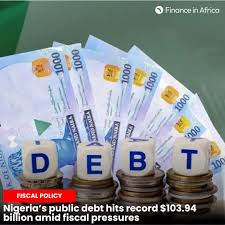
Debt servicing surpasses capital spending by N3.9tn in two years
Recent reports and fiscal analyses highlight a significant imbalance in Nigeria’s public finance, where debt servicing has surpassed capital expenditure by approximately ₦3.9 trillion over a two-year period (specifically between 2023 and 2024).
This trend underscores a "liquidity squeeze" where the cost of borrowing is effectively crowding out investments in infrastructure, healthcare, and education.
Key Data Points
The Gap: Between January and September 2024, the Federal Government spent ₦8.93 trillion on debt servicing, which exceeded the ₦5.85 trillion allocated to capital expenditure by over ₦3 trillion in just nine months.
Revenue Absorption: Debt servicing consumed roughly 61% to 64% of total generated revenue in 2024. In some quarterly windows, analysts noted that for every ₦100 earned, more than ₦60 went toward interest payments and debt obligations.
2025/2026 Projections: The 2026 budget proposal earmarks ₦15.91 trillion for debt servicing. Economists warn that if revenue doesn't scale proportionally, debt service could consume over 90% of revenue by 2027.
Why the Gap is Widening
Naira Depreciation: Since much of Nigeria’s external debt is denominated in foreign currency, the devaluation of the Naira has automatically inflated the cost of servicing those loans in local terms.
Higher Interest Rates: The Central Bank of Nigeria (CBN) has aggressively raised interest rates (reaching 27.5% by 2025) to combat inflation. This has significantly increased the cost of domestic borrowing for the government.
Revenue Shortfalls: While non-oil tax collection (VAT and CIT) has improved, oil revenues frequently fall short of budget targets due to production challenges, leaving the government to rely on more debt to fund its operations.
Economic Impact
Infrastructure Stagnation: Capital expenditure is often the "first casualty" of fiscal pressure. When debt and personnel costs (salaries) are paid, there is little left for new roads, power projects, or rail.
Credit Crowding Out: High government borrowing from the domestic market keeps interest rates high for the private sector, making it difficult for small businesses to access affordable credit.
Sustainability Concerns: Nigeria’s debt-to-GDP ratio has climbed toward 39%, nearing the statutory limit of 40%, leading to calls from the IMF and local analysts for urgent fiscal reforms.
As of March 2026, the data from the Debt Management Office (DMO) and recent fiscal reports show that Nigeria's debt profile has shifted significantly, with domestic obligations now carrying the heavier weight in terms of both total volume and servicing costs.
The total public debt stock as of June 30, 2025, stood at ₦152.39 trillion (approx. $99.66 billion). By September 2025, this rose further to ₦153.29 trillion.
1. Breakdown: Domestic vs. External DebtThe current strategy shows a slight tilt toward domestic borrowing to mitigate the impact of exchange rate volatility on foreign loans.
Category Amount (Approx. Sept 2025) Percentage Key Creditors / Instruments
Domestic Debt₦81.81 trillion~53%FGN Bonds (bulk), Treasury Bills, Savings Bonds, Sukuk.
External Debt₦71.47 trillion~47%World Bank ($18.04bn), Eurobonds ($15.1bn), China Exim ($4.9bn).
Federal vs. State: The Federal Government accounts for 92.6% of this total debt (₦141.08 trillion), while the 36 states and the FCT hold the remaining 7.4% (₦11.32 trillion).
2. The Debt Servicing "Liquidity Squeeze"
The reason debt servicing has so aggressively outpaced capital spending is due to two primary "cost spikes":
Domestic Interest Rates: To combat inflation, the Central Bank (CBN) raised the benchmark interest rate to 27.5% in 2025. While it recently eased slightly to 26.5% (Feb 2026), the government is effectively paying "credit card rates" on its trillions in domestic bonds and bills.
Devaluation Effect: While external debt is smaller in volume, the cost to service it in Naira has exploded. Interest payments that cost ₦460 per dollar in early 2023 are now being settled at rates above ₦1,500 per dollar.
3. Impact on Capital Spending
The "₦3.9 trillion gap" you mentioned is reflected in the actual release of funds to ministries:
The 0.016% Reality: In a recent Senate hearing, the Minister of Health revealed that his ministry received only ₦36 million out of a ₦218 billion capital allocation for 2025—a release rate of less than 1%.
Revenue Absorption: In Q2 2025 alone, debt servicing reached ₦4.44 trillion, while total revenue for that period was only ₦5.23 trillion. Essentially, after paying interest, there was barely enough left for government salaries (recurrent expenditure), leaving "zero" for new roads or power plants.
Summary of Risks for 2026
The 2026 Appropriation Bill currently before the Senate proposes a budget of ₦58.47 trillion, but lawmakers have flagged it as "unrealistic" because it projects ₦15.91 trillion just for debt servicing.
The IMF projects Nigeria’s debt-to-GDP ratio will decline to 35% by the end of 2026, but analysts warn this is a "paper recovery" due to GDP rebasing; the actual cash-flow (liquidity) remains critically tight.